
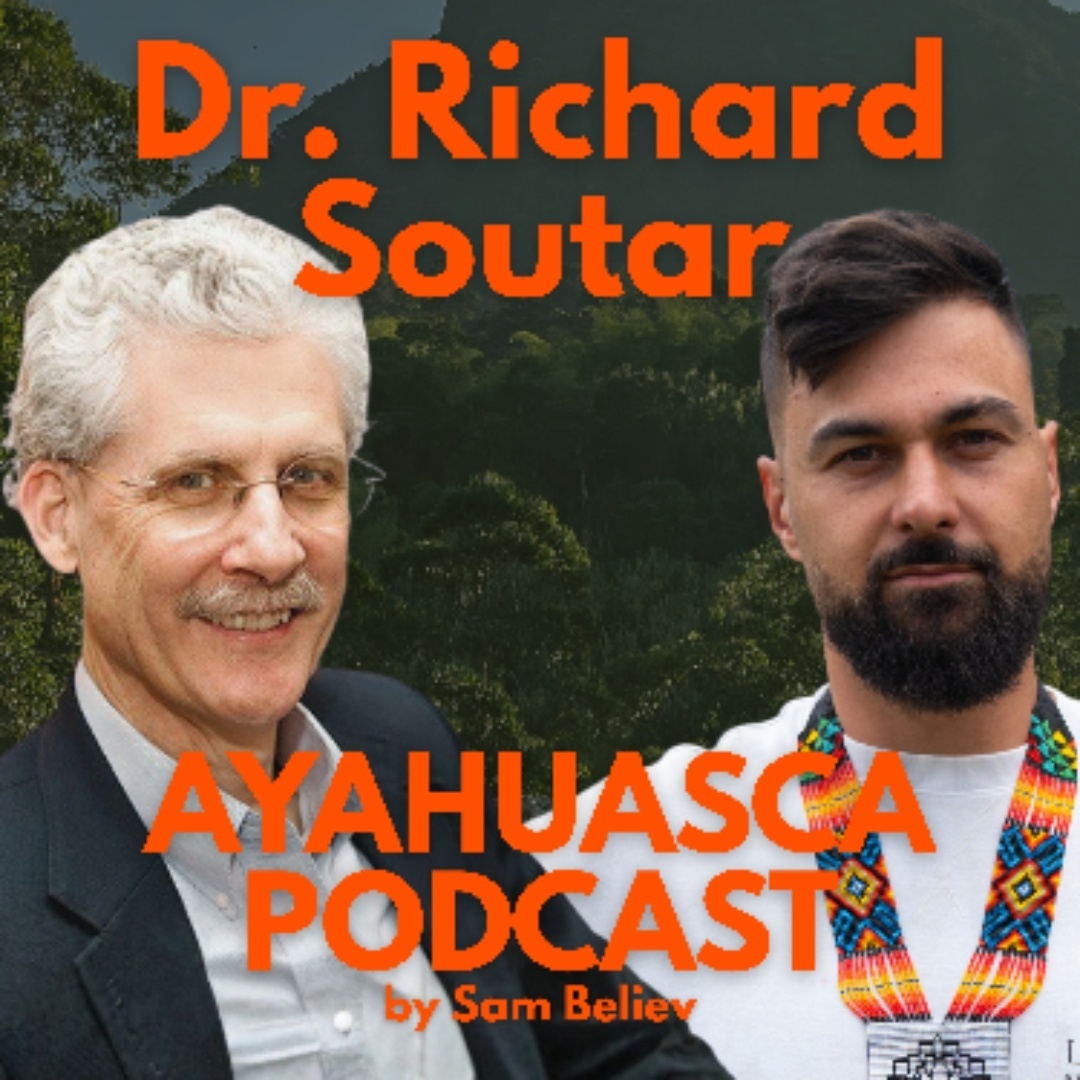
In this episode of Ayahuasca Podcast, host Sam Believ (founder of http://www.lawayra.com) has a conversation with Dr. Richard Soutar. Dr. Soutar is a neuroscience pioneer and the Chief Scientist at New Mind Technologies. With over 30 years of experience, he is a world-renowned expert in QEEG brain mapping and neurofeedback, dedicated to bridging the gap between modern technology and ancient spiritual practices. He has mentored groundbreaking research into the neurological effects of Ayahuasca and Wachuma, helping practitioners use neurofeedback to integrate and sustain profound shamanic shifts.
We touch upon topics of:
- 03:45 – Dr. Soutar’s early spiritual awakening and experiments with altered states in high school.
- 07:20 – The realization that psychedelic experiences mirror high-level meditation with added “sensory noise.”
- 10:15 – Discovering neurofeedback as “electronic yoga” for inducing deep meditative states.
- 14:30 – How neurofeedback serves as a “crash course in reality” following psychedelic breakthroughs.
- 17:10 – The role of the default mode network as a portal between dimensions.
- 21:05 – Defining neurofeedback: Selective feedback loops and operant conditioning for brain exercise.
- 24:50 – Using topographic QEEG brain maps to identify areas of low or high electrical activity.
- 27:30 – Scientific findings: How Ayahuasca pushes the brain toward optimal statistical norms.
- 30:15 – The “drift” factor: Why psychedelic improvements often dissipate after three months without integration.
- 33:40 – The paradox of Ayahuasca: Upregulating or downregulating the same brain areas based on individual needs.
- 37:20 – Accessing “liminal states” between waking and sleep for trauma resolution.
- 41:10 – How psychedelics and meditation can alter DNA and RNA to heal transgenerational trauma.
- 45:00 – Shaking up the system: Using neurofeedback to sustain the neuroplasticity triggered by medicine.
If you would like to attend one of our Ayahuasca retreats go to http://www.lawayra.com
Find more about Dr. Richard Soutar at http://www.newmindtechnologies.com
Transcript
Dr. Richard Soutar: I adopted approach that psychedelics were a wonderful crash course in reality, a way of breaking through, a way of directly experience the limitations of everyday reality and how it could blind you towards what the fundamental reality of the universe. Psychedelics shake the system up. They… It generates neuroplasticity.
You are rigid when you come into the psychedelic experience, and then it shakes you up. Psychedelics are great up to a point. Once they open you up, you have to go on the journey in your everyday consciousness, in your everyday experience, and find the path forward in everyday life. Old age is a forced march into non-attachment, which describes old age really well, being a senior.
All those things that you didn’t wanna let go, you’re being forced to. But if you don’t have that golden thread of spirit, spiritual practice to latch onto you go into a tailspin.
Sam Believ: You’re listening to AyahuascaPodcast.com.
Hi guys, and welcome to Ayahuasca Podcast. As always, we’re your host, Sam Belyav, and today I’m having a conversation with Dr. Richard Suiter. I highly recommend you listen to this episode of Ayahuasca Podcast where I had a conversation with Richard Suiter. He is a pioneer in neurofeedback, and together with his mentee, Luke Jensen, we are doing some science here at LaWayra where we do qEEG brain maps on people before and after their ayahuasca experiences so we can see the results, and we talk about that.
We talk about what is brain mapping, what is neurofeedback. We try to bridge science and spirituality. We talk about the paradox in which in some people, a certain area of the brain is down-regulated and ayahuasca upregulates it, and in a different person, the same area can be upregulated and ayahuasca downregulates it, which kind of scientifically explains the concept that we constantly mention, that ayahuasca gives you what you need.
We talk about neurofeedback as a tool for integration, the transcendent brain states, how you have been meditating wrong your entire life, and how to check if you’re meditating correctly, and many more. It’s a fascinating episode, and I highly recommend you check it out. And don’t forget to leave us a five-star review on Spotify.
Thank you. Dr. Richard is a neuroscience pioneer and sh- chief scientist at NuMind Technologies. Dr. Richard is a world-renowned expert in qEEG brain mapping and neurofeedback with over 30 years of experience, bridging the gap between modern technology and ancient spiritual practices. As the founder of NuMind Technologies, he has developed the sophisticated databases used by clinicians globally to analyze brain health and performance.
Beyond his clinical work, Dr. Suiter is a leading voice in spiritual neuroscience. He has mentored groundbreaking research into neurological effects of ayahuasca and wachuma, providing a scientific lens into the shamanic state and helping practitioners use neurofeedback to integrate and sustain the profound shifts experienced during the plant medicine ceremony.
This episode is sponsored by LaWayra Ayahuasca Retreat. At LaWayra, we combine affordability, accessibility, and authenticity. LaWayra, connect, heal, grow. Guys, I’m looking forward to hosting you. Dr. Suiter, welcome to the show.
Dr. Richard Soutar: Thank you very much
Sam Believ: Let’s start by getting to know you. Tell us your story and what in your life gave you the curiosity to study the brain and and what you’re doing now?
Dr. Richard Soutar: At in my 70s, my story is quite long, but I’ll try to truncate it because it’s mostly a spiritual journey, and that’s how I’ve always looked at it from when I was very young. So in junior high school I woke up one day, I had an experience and was very interested in metaphysics and very interested in hypnosis.
And I started experimenting with different devices to try to change my brain and what I experienced. I have no idea why. Those were just things I was doing. I did experiments with ESP with my friends. I hypnotized them. I developed a photic machine to to change those states of consciousness, and I also used transcranial magnetic stimulation.
And I was experimenting with all these things in high school and altered states because I wanted to try to see around the curtain of reality. I think by the time I was… got to high school, I was interested in yoga. I was practicing yoga a little bit on the side and continued investigating Eastern religion.
When I got to college, I was by that time I was into psychedelics And I had been meditating quite a bit, and I had some intense experiences in meditation which altered my view of reality. And when I did the psychedelics, I had experiences similar to ones I had in meditation, only there was a lot more turbulence at the sensory level.
And it really dawned on me that the psychedelic experience was essentially the same as high levels of meditation experience, except there was a lot of noise, a lot of sensory noise, which a lot of people couldn’t s- couldn’t see through. They were distracted by it, and they liked… they thought it was fun to play with the sensory experiences and weird states that they encountered.
And but some of them had profound spiritual experiences, a lot of them. And often I was the only one around to relate to on that level during those experiences. And I got very popular with my friends for being present during those experiences when they were back in those days we called it tripping but I was also really interested in the mechanics of it.
I was a psychology major and was really interested in what was going on in the brain and how to create a roadmap to get to the experiences I was having, and to take the experience even further. The point being, I was in- really interested in understanding what Satori is or Nirvana, things like that.
I knew that extrasensory perception and things like that was not my goal because I had been reading Christopher Isherwood’s book on yoga and yoga philosophy the aphorism of Patanjali. And it was clear that all of these fantastic experiences and powers that people briefly experience were just another distraction like the sensory ones.
And I began to realize that underneath all these experiences was a substrate that really made the experience wonderful ultimately, and was the ground of what they were all chasing. You go into these psychedelic experiences and say “Oh, we would all say, “Oh we’ve got the answer.”
And then when we came off the experiential… off the psychedelics, we’d go like what a weird answer. Why did we think that was the answer?” Like you would say, “Oh nothing is everything, and everything is nothing. That’s all quite clear.” And you would return to your everyday experience and go, “That doesn’t make any sense.
What w- about that was quite clear?” So I really worked at studying that s- those states and reading more books on the topic. One in particular I read was The Psychology of Meditation which is way out of print, but talked about the EEG and meditation, and that there was a certain EEG signature to meditation.
And I was interested in using EEG as a way to get to those different states and different experiences. So when I went… I briefly took a detour in playing in bands and rock and roll but then I got out of that and I went down, To Arkansas and built a house in the woods.
And down there we met a shaman and his wife, who was a PhD in psychology, and she turned us on to shamanistic techniques for getting into those states. And my wife took up shamanism at that point and studied that with Lynn Andrews So we were constantly in pursuit of these experiences and methods for inducing them and understanding them.
And I was studying it also in school, in graduate school. And that’s where I met my advisor who was also doing EEG work that had just started surfacing called neurofeedback. And he… I went to his clinic, and he did a lot of neurofeedback. He was very advanced technique that he was probably 20 years ahead of the people at, of his time.
And those techniques resulted in very high levels of meditative-like experiences really high levels. I had profound experiences doing alpha-theta training there, and so did my wife. And they duplicated the ex- They were the same experiences that were described by all the main people promoting meditation.
And they were consistent with the Upanishads and other philosophies. And we said, “This really is a technology that can take you there.” So from that point on, I adopted approach that psychedelics were a wonderful crash course in reality, a way of breaking through, a way of directly experience the limitations of everyday reality and how it could blind you towards what the fundamental reality of the universe and, but it was a wonderful introduction, and the neurofeedback we were doing, the alpha-theta, was a wonderful follow-up. We really focused on alpha-theta because it was pretty easy to get psychedelics, but it was almost impossible to find somebody who had a really deep understanding of spiritual traditions Eastern philosophy and brainwave technology.
So we spent all the years since then perfecting that technique on the side. My main everyday life was training people with mental disorders or who wanted peak experiences or who wanted to do peak performance. And so for the last 25 years, I’ve been training everything from people who were lock-ins and couldn’t do anything with their body other than hear and see, all the way from athletes professional athletes who wanted to be peak performers And I worked with, people who had schizophrenic, severe depression, bipolar disorder, and they all had different experiences of reality.
I found that my background really helped me understand their experiences of reality, and I could talk to them in a language in a vernacular which was very familiar to them. Since I could describe their experiences to them, they thought I had a similar experience, and I explained to them that was my background, but I know what the human brain can do and what kind of experiences it’s capable of.
So from that w- perspective, I was really able to build trust with them and help them with neurofeedback, regulate their brains, and diminish a lot of their symptoms of mental disorder or head trauma or other things. Athletes would come to me and with head trauma, and they needed remediation.
And I did that, and did it successfully. People with stroke came to me also, and I helped reduce their symptoms sometimes almost to miraculous levels, which was always astounding to me. But brainwave training was a powerful tool both for healing and for for healing and for pursuit of optimal experiences and optimal performance.
You could tune up the brain and, But it all this really made me realize that the ultimate power of it, like Patanjali says, was to connect you with the fundamental experience of reality, which is the substrate of our everyday experience. There’s a reason we have a default mode experience, because everyday experience is the portal between all these dimensions.
You can go all these different places, but you always come back here. And there’s a reason for it being the default mode, because you can’t maintain your existence in this dimension if you can’t navigate it and take care of yourself and heal get the right sleep get the right exercise get the right food.
You can’t optimally perform. Somebody who wants to meditate can’t meditate optimally if they’re aren- they aren’t doing all those things. And there is a a term for that in yoga, yamas and niyamas. Building the moral and physical abilities which enable you to have optimal performance and optimal experiences of reality And what I, when I got together with Luke, I recognized a kindred soul much younger than me and what journey he was on.
He had the unique ability… He had spontaneous lucid dreams of, That were very unusual in the
Sam Believ: literature Let, let’s give let’s give listeners some perspective ’cause not everyone knows Luke. Richard, Dr. Richard Suter is mentor for Luke Jensen. Luke Jensen I’ve interviewed him maybe 20 episodes before this.
He is the founder of Neuro Enlightenment, which is the company with which we as LaWayra partnered and started collecting data on people at the retreat before and after the Ayahuasca experience. So we’ve we’ve now collected probably more than a couple hundred samples of brain QEG brain maps before and after, and found some very fascinating things.
So we’re planning to do a study and also we offer to people neurofeedback as a tool for integration post-retreat. So that’s that’s Luke Richard’s mentioning. So yeah I, I think Luke found you and you were very excited to meet him because you were looking for someone like him to explore with with the psychedelics because I think the unique you have this unique perspective where you you have dealt with psychedelics yourself and you’ve explored it, so you were not closed like some people in the scientific sphere that would be like, “Yeah, no, this is not cool.
Only, science is cool.” But you have the complete picture. So yeah, I I think that’s enough of perspective, so let’s go back. Tell the story.
Dr. Richard Soutar: Yeah. Thank you for that. I often leave things like that out. I’ve got so much coming and going in my i-i- in terms of what I wanna say.
But, there are scientists, a lot of them who speak from complete ignorance, and unless you’ve had a psychedelic experience, you only have half the information. That’s part of my approach to science is to integrate qualitative and quantitative data. And science, up until very recently, has only focused on quantitative data and is now realizing that qualitative data is something that has to be explored scientifically and is the other half of the story.
And a lot of my interest has been in quantum mechanics and people who are working on game theory in terms of expecting, exploring reality. There’s incredible support in science for what we’re doing. David Bohm in particularly wrote about the implicate order, and I think I’ve read his book four or five times.
He’s a brilliant physicist who developed a, quantum holographics and how everything is connected both in terms of physics and the equations that he’s derived, and it’s connected holographically. So every part of the universe is contained in every other part of it to some degree, and that’s part of the reality that you experience in meditation or psychedelic experiences.
It’s an aperture a doorway into seeing the fundamental nature of all things and getting in touch with that, and also seeing it in yourself. That’s fundamental to psychedelic experience if you don’t get distracted by all the beings and the dimensions and the sensory stuff. Those are interesting journeys, but like Potenza says, they’re just journeys, and they’re journeys of knowledge.
If you take them, they’re good for you because you… They are offering you knowledge to resolve your attachments. All these beings you run into, the dimensions- … are healing you by taking you on small journeys to play out your own personal drama and to relinquish your own personal attachments.
Because
Sam Believ: it’s calling- Yeah, so one of the very underlying things with all psychedelic experiences, different types of psychedelics and also like spirituality. Spirituality is large, is that understanding of us all being connected, and I think that’s the core of it. But before we go deeper, I think we need to educate the, the audience about what is that you do, neurofeedback and brain brain training, ’cause they don’t really know. What is, Let’s let’s teach them. What is neurofeedback? What is brain training? What is it that we do, and kinda in a more practical way?
Dr. Richard Soutar: Yeah, I’ve written several books on it which you can find on Amazon, which are, which can take you to the depths of it in every dimension.
But essentially, you’re taking a person’s brainwaves, and everybody has fundamentally the same set of brainwaves, and we give… We break the brainwaves down into categories, and we give names to them like delta, theta, alpha, beta. And you can take any one of those categories of brainwaves and put sensors on somebody’s head and record them in real time, and you can see them on your computer screen.
And then you can t- you can pick and choose which of those brainwaves you want to feed back to the person. And so you create a feedback loop be- between the brain and itself, a selective feedback loop to enhance certain brainwaves or reduce certain brainwaves. And by doing that, you change you…
it’s like a form of exercise choosing particular muscles and particular weights to work on to develop them. You can develop your thigh muscles or your lats or your pecs by picking different weights and doing different exercises. You can do the same thing with your brain. You can strengthen areas or diminish the strength of areas that are participating in the brain by choosing brainwave frequencies and feeding them back to the brain, and it’s a form of exercise as well as a form of learning. That form of learning is natural to the brain because that’s what it does to all perception. It takes in perception, it selects certain perceptions, and then feeds it back to itself. We are, are– we select our own perceptions and there’s a confirmation bias to everything we do.
We, in a way, we create ourselves as much as the world creates us through the selections of the sensory input. Brainwave technology allows you to select where you’d like to have strengths and train those areas. The– It works through what’s called operant conditioning in psychology. And that’s basically the model for how all animals learn.
And then there’s also a type of learning which is called task learning, which is non-conscious involuntary learning, and that’s the way children and babies learn language and baseball and everything else. Most of sports is task learning. It’s involuntary learning. In the neurofeedback that we do at NuMind, we focus on involuntary task learning.
And we… That’s the most effective we found, and it’s a natural and easy way to train your brain. So you can make a map of your brain, an electrical map, and with our equipment and it looks like a topographic map mountains and valleys on a topographic map. You can make maps of the electrical activity in your brain determine which areas are unusually low or high, and you can train them creatively in different ways to improve brain function or get rid of symptoms you might have.
So y- you’re using that mapping technique to see what happens before and after Ayahuasca or mescaline, and we’ve looked at that too. And we found that Ayo- Luke and I found that Ayahuasca generally pushes the brain into a more optimal state than most people, which is a a really cool thing to find.
Nobody had ever looked at that before. And so Luke is pursuing that and similar projects a- with you And you’re the only one really doing that kind of work. It’s interesting, back in the in, in the ’20s and ’30s they first is- isolated mescaline in the labs, and then later on LSD. But a lot of the European intellectuals were, and writers were exploring hallucinogens and writing about them, and some very famous writers, and they wrote novels based on them, which are very famous novels.
And there were also visual artists and composers. So it has been a natural progress for our civilization on the artistic or qualitative side to incorporate th- this type of psychedelic experience. But we’re doing it now in a scientific way. And we’re just on the ground floor of it and just starting it.
There’ll be scientists with greater skills and greater equipment down the road, but right now we’re all pi- pioneers of this, and it’s an exciting place to be. But the most exciting thing to me is that we’re paving a road for others to be a- able to access these optimal experiences of being connected and complete.
And and that also optimizes their experience of life and their relations with other people, and optimizes life for all of us and our c- the communities we’re in. So this has very little downsides if it’s done properly.
Sam Believ: So Luka, Luke said you’ve seen some of the results from some of the information that we collect here before and after, and that you were very impressed with the changes.
What have you observed with the changes in the brain after people doing a one-week Ayahuasca retreat?
Dr. Richard Soutar: A, a brain map is a database like ours has– collects ours has millions of maps literally from people from all walks of life, and we have assessment ins-instruments, and we can look at people who have extreme disorder in their life, and people have high levels of order and are optimal performers, and we map all those people.
So we can clean the data and make it anonymous and then analyze the data for what that spectrum of experience looks like in terms of brain map, that life experience. So people who are optimal performers, we can find them and look at them and create a database, which we have done of of highly functional people.
And so we know in terms of electrical activity what highly functional people look like. And when we map you before an ayahuasca experience, we look at how different you are in terms of functionality with optimal people. And then after the ayahuasca experience, has that changed? And we find that almost everybody moves more towards the norm, statistical norm of our database for optimal functionling– functioning as a consequence of ayahuasca.
But what we wanna look at is how long does that last, because often from psychedelic experience, that improvement dissipates to some degree over a period of about three months. The same thing happens in transcranial mag-magnetic stimulation. Because the brain tends to return to its old patterns those are the ones it feels at home at and which it finds as most successful in the life that a person has created for himself or herself.
But, the psychedelic experience says you have to change your life experience. It challenges you, but most people don’t change it that much. They drift slowly back towards it. So we wanna see how long that experience is sustained, how long the drift is, and we try to measure that, And at the same time, we can put people on neurofeedback training after those experiences and see how lo- much longer they can sustain or even improve upon those changes in the psychedelic experience.
And that’s a really cool thing because I’ve taken people who’ve done transcranial magnetic stimulation a- and other types of interventions and were backsliding and stopped the backsliding and moved them forward again and improving their functionality and even transcending the level they were at.
So that’s exciting. By mating these two technologies together, you have a powerful technology for transformation.
Sam Believ: So Luke’s finding was that if, let’s say, some area of the brain is overly active, then the psychedelics make it more closer to normal. And if, i- if in this, in a different person, the same area of the brain is underactive, it pushes it up more towards normal.
So it’s very paradoxical from the point of view. It’s it’s a it’s a, it’s same as saying if you have a cup of coffee and when it’s morning it activates you, but then if you drink the same coffee in the evening it makes you more sleepy. So how does the same substance pushes the, the area of the brain up or down depending on what’s needed and it combining that question with how do you think psychedelics work on the brain?
Like basically with your knowledge as as a scientist and like everything you know about the brain, what is the mechanism in your opinion?
Dr. Richard Soutar: Yeah. There is very little information and people who speak knowingly about it are just speculating because there is very little research on that actually and there…
That’s what we need. That’s why we’re doing this. Again, this is just the ground floor of it may even be the basement of all this investigation into these technologies. But psychedelics do something similar in terms of arousal to meditation in that it moves the center frequency of the brain slightly lower.
And so puts them in a state between a special type of liminal state, and we talk about liminal states in anthropology a lot. Drumming can put you in liminal states. Fire gazing can put you in liminal states. Pain can put you in liminal states. The Cheyenne did the sun worship exercises which caused horrific pain and it put them in those states.
Psychedelics can put you in states. So their liminal states are a great variety of states in between waking and sleep. The human brain in our civilization we look at it as there’s waking and there’s sleep, and there’s nothing in between. But actually in the literature, and if you look at the brain while it’s doing different things, there are a whole host of states.
I liken it to being thinking that you only live in a two-story house and you work in the upstairs floor, and when your day is done, you get in the elevator and go downstairs to go to sleep, and your consciousness drifts into sleep. When actually you live in a, a, a high-rise building and there’s lots of floors and lots of things going on them, but you go zooming past them because you’ve never been told they’re there and never been taught how to access them.
But our ancestors developed a lot of primitive technologies, including plant medicines, for gaining access to those different levels of consciousness. When you change the arousal level of the brain, you change its functionality dramatically. You have access to different information in terms of perception and abilities at different levels of arousal.
We use subtle levels of arousal shifts during our waking day. Now you focus intensely on something or you relax your focus, and as you do that, your heart rate and your respiration and different, your whole hypothalamic pituitary axis, all of it alters as you do it and it adjusts, when you take drugs, again, that adjusts the whole physiology and brain state of the person. But these liminal states were where people went to deal with trauma of everyday life because it was brutal in primitive world. And most people today can’t understand unless they live in some place like Gaza or Ukraine, the brutality of primitive life often was And for much of early civilization.
And most of our species is traumatized and we behave in ways which reflect that trauma and pass it on to our children, and it’s called transgenerational behavior. And indeed, there’s lots of evidence on the scientific level that it’s also recorded in our RNA. And there’s been studies that found that meditation can alter the DNA and RNA of a person, and no doubt psychedelics can do the same.
So they shake up our DNA and RNA at a fundamental level, at least temporarily, and they alter our arousal system. It’s almost like whenever you go through te- intense experiences, you you have… It throws you off balance, and then you have to, Process a long time to rebalance yourself. And out of that reorganization or processing in your brain, you come up with new insights and new learning that enhances your functionality.
With trauma, that process gets blocked. You shrink from engaging new ways of being, thinking, or doing. But psychedelics shake the whole system up, just like intense other experiences. It’s why people go for skydiving and so forth. All these intense experiences force upon you a reorganization at a neurological level of large-scale networks which are in the brain, which process information force different kinds of pathways to integration between ancient primitive parts of the brain which are involved in emotion and help to educate you, change you, make you more functional.
But if you’re overwhelmed by trauma, they tend to block it. And things like psychedelics and neurofeedback can… and ritual, drumming, chanting, dancing like Native Americans do, can help put you in states of consciousness where you’re able to integrate all of that trauma and gain back your balance and ground you in your natural creativity, and that generates more vitality and higher functionality.
So it’s always, the world is a challenging place, and that’s good for us in pushing us to our limits. But it’s not good for us when it pushes us beyond our limits, and we can’t get back on our feet, and that’s what leads to a lot of mental disorder So these ancient practices are healing to us.
They can be incorporated in plant medicine can be incorporated into the new technologies like neurofeedback, which is just another form of our effort to recover from trauma, to integrate, and to have optimal experience. So really, we’re carrying on the tradition in the, the modern world. It’s just that technology is our vehicle rather than plant medicines and dancing and singing.
And that doesn’t mean we should exclude them. We should incorporate them, just like yoga. Yoga’s a higher level of all of those. Yoga came out of that effort to integrate, to overcome trauma. And yoga’s older than Buddha, and Buddha really wasn’t that successful until he integrated yoga. And that’s…
So that ancient tradition, that refinement of it in ancient methods and eventually in yoga, has now shown up in our civilization as neurofeedback. We’re going up one level, and the next level may be-
Sam Believ: You call it electronic yoga, right?
Dr. Richard Soutar: Yep. That’s the way everybody who’s experienced it at a deep level has described it
Sam Believ: This episode is sponsored by La Wayra Ayahuasca Retreat.
Most of La Wayra if you’ve been listening to this podcast for a while. Some of you might have already been to La Wayra before. For those who don’t know us yet, we started La Wayra four years ago. At La Wayra, we combine authenticity, accessibility, and affordability. La Wayra is currently highest-rated Ayahuasca retreat in South America with more than 700 five-star reviews and an average rating of five stars.
If you come to La Wayra, you’ll experience powerful, authentic ceremonies led by our indigenous shaman, Fernando, in a very beautiful venue just one hour south of Medellín, Colombia. We’re surrounded by nature and have comforts like hot water, Wi-Fi. At La Wayra, our team has guided more than 2,500 people through this life-changing transformation of Ayahuasca experience.
At the same time, we keep it very affordable. So whether you’re coming for healing, clarity, or a deeper connection to yourself, La Wayra is the best choice. If it is your first time drinking Ayahuasca, you will love our three-and-a-half-hour preparation course and integration support. All of that is included in price as well as pickup from Medellín, accommodation in Ayahuasca.
Visit lawayra.com to book your retreat or learn more. La Wayra, connect, heal, grow. L-A-W-A-Y-R-A.com. Buddha didn’t have those kinds of tools maybe we get new generations of Buddhas that are forced, that have both psychedelics and neurofeedback, and yoga, and meditation, and AI maybe
Dr. Richard Soutar: we’ll get them- I
Sam Believ: think so.
Dr. Richard Soutar: I think so.
Sam Believ: Yeah.
Dr. Richard Soutar: It’s a very promising thing, and we have to do it, they s- they have a saying at MIT, most of the best discoveries take place in the garages outside of the campus rather than on campus.
Because it’s so constrained by formality and tradition that real exploration and discovery can’t take place except on the fringes of the university,
Sam Believ: Yeah. That makes a lot of sense. You talk a lot about default mode network and you have deep understanding of it. Let’s talk about this because obviously psychedelics affect default mode network, and so does neurofeedback. What is the role of default mode network and healing from trauma and like those rigid patterns?
Dr. Richard Soutar: It’s it’s the focus of the public and clinicians. People in psychology are very focused on it. But it transcends the default mode network. There are three major large scale networks which are involved in it, the central executive, the salience, and the default mode. And they work together.
The central executive is focusing on the outer world, and the default mode system is focusing on the inner world. It’s a self-referential. Whenever you think about yourself or how you interact with the world you’re looking up or in backwards into your mind. That’s… you’re engaging the default mode network.
When you look outward, you’re engaging the central executive network and analyzing the world outside you. The salience network is your attention, and it shifts from external to internal constantly all the time. People with mental disorder tend to get stuck on the internal. There are versions of mental disorder where they’re stuck on the external.
What you want is a healthy balance. That’s how the system works the best. So it’s really the three networks. And the person who proposed that theory was one of the was one of the people who did a meta-analysis of MRI research. And he was a expert in s- exploring sca- met networks and how they scale in the human brain and how they work.
And he proposed this just around af- 2011, 2012 this triple network theory. And it– that’s really the dominant theory, and it’s really the most useful one to use even when you’re talking about psychedelics, about those three networks, and you can
Sam Believ: Google that Yeah. So we talked about how the improvement with psychedelics, it’s very strong and it’s very powerful and it’s very quick, but then the improvement starts to dissipate.
And that’s why what we’re trying to do here is to bring neurofeedback. Of course, we… people that are leaving the retreat, we provide them with ideas for behavior changes to keep themselves in that state. And actually we provide them with integration journal so that they can take the information they got from the psychedelic experiences and then implement them- Very important
in their life. And one of those things now is also the neuro the brain training or neurofeedback. We want them to go back home and start doing it. Of course, it’s it’s a technologically complex process and it costs some extra money and, But what do you think is the mechanism there? Of course, like we see and we think it’s a good tool.
How do you think it work? Is it because the psychedelics provide the neuroplasticity and then, Exactly … neurofeedback can take place faster? What do you think about that?
Dr. Richard Soutar: I think that’s exactly it. You hit the nail on the head, and I never told you that, or you never mentioned it, but it became obvious to you.
And I think it becomes obvious to everybody. Like I said, psychedelics shake the system up. They it generates neuroplasticity. You are rigid when you come into the psychedelic experience, and then it shakes you up. That was, part of the reason Luke used martial arts in, in his in his clinic to prepare people for the experience.
Because martial arts is like yamas and niyamas in yoga. It’s the exercises to prepare you for meditation. You have to do exercise to prepare yourself for for the psychedelic experience if you really wanna get the optimal experience out of it. And that kind of discipline carries over after the experience.
Having developed whatever degree you can of that discipline, you can now apply that discipline to other areas of your life. So if, for instance, you pursue martial arts at a high level, sooner or later you run into a master teacher who starts teaching you about how to manage energy and focus. And and there’s a spiritual aspect to it.
And that’s critical to optimal martial arts, for instance. So- That introduces the highly trained person to a new level of experience and discipline that optimizes their life. If you add neurofeedback into that that creates A way of supercharging that ability, ’cause people don’t always fully optimize their discipline.
Neurofeedback can help you develop discipline, can help you get control over urges, can help you manage the areas that are a weakness for you in life. And so neurofeedback I’ve trained people in martial arts and sports in golf in particular. They’ve been astounded by how it’s optimized their ability.
I’ve worked on, last 25 or 30 years with golfers and top executives. And it was interesting ’cause all the top executives play golf, and all of them said I’m really here to optimize my experience in the boardroom.” And I always say what about your golf game?” They say that doesn’t matter.”
But after a month of training, they say, “I’m killing it on the golf course. I love this technology.” I say what about your boardroom?” That’s good too, but that’s not as exciting as the golf.” So you see, it’s it’s what they love to do, and their creativity and ability on the golf course is massively enhanced, and they’re successful.
They’re beating all their friends in competition, and that carries over into their business experience and their confidence in their business experience as well. So there’s different ways that you can train and manage your discipline. That’s part of what art is. Art disciplines you to and teaches you to manage both your mental and physical abilities.
These are all going back to discipline and creativity and insight these fundamental skills, and I think at the heart of it is creativity. Every human being at the center is a highly creative being, and that creativity is generated from the same source as our life itself. Life itself is an expression of creativity and play.
And if you can discipline yourself through recreation that’s the highest form of discipline. Whatever you love to do, tennis, golf skiing crocheting even.
Me too.
Sam Believ: So one one thing that happened to you personally, and I know you’re not just a creator of the method and chief scientist, but you’re also using it on yourself, and something happened to you.
I don’t know if you wanna talk about it, but about the case of long COVID you had and how you recovered from it using- Oh, yeah … the technology.
Dr. Richard Soutar: I think it’s very important to get the word out. I had long COVID and as you may or may not know, COVID causes the blood to thicken and coagulate, and that’s often what kills people.
It does that in different organ systems, and I’m being very simplistic, but basically that’s it. It also ha- causes that in the brain, and that happened to me in the, in my brain as a consequence of long COVID. I had a minor stroke, and I lost my ability to speak, to work on the computer to work my cell phone.
I was basically, My wife said you s- you look and sound like an idiotic drunk that I f- got out of the alley.” And I couldn’t function at all, or speak or anything. I could make… I could try to speak, but the words were all mumbling. Sounded like I was drunk all the time. What I did was I meditated.
I did neurofeedback, and of course, I did I practiced keyboard. I took up the keyboard especially. I always wanted to focus on it more, and practiced that to get my brain and my hands working, which are critical for motor f- function. And between the neurofeedback and the keyboard work, I, got most of my functionality back.
Now if I get tired I have trouble remembering words. And I still don’t do recall As good as I used to. I used to be able to recall in detail names and dates and research going back 20 years. I can’t quite do it at the same level, but it’s pretty close. That was a real eye-opener for me. And I’ve had s- lots of experiences like that with neurofeedback going through physical challenges.
But also i- in my work in a– as a clinician, dealing with all of other people’s physical challenges and seeing them go through it at a very personal level gives a real insight into h- human resilience, the ability to human beings recover. We got people who were in their wheelchairs and couldn’t talk, and one side of their body w- couldn’t function, and we got them up walking and talking and in some cases driving again and living a, a normal life.
They weren’t perfectly normal, but they reorganized their brain to a point where they could do all the activities of daily living and live a life that was worth living, where they felt they had value and could contribute to life as
Sam Believ: well. Yeah. Thank you so much for sharing your story and congratulations on recovering so well because you’re smarter and you speak better than most people that never had a stroke.
And I’m wondering if, I wanna invite you to come here with Luke sometimes and do an Ayahuasca retreat with us, and then do some more brain training and see if that takes you even to to, to the next level. Because obviously with that neuroplasticity and some other effects that Ayahuasca can have on you.
I have my next question is, you talked about high performance and obviously talked about healing, and that’s also there’s a parallel both with neurofeedback and work with Ayahuasca because some people come here to heal and some people come here to learn about the world and do spiritual expression and grow, and you can achieve both depe- depending on which stage of life you’re in.
How different or how similar is that process? And yeah, do people just heal first and then they start, becoming better at things, or it just happens simultaneously? Is there a way to choose what you wanna work on at this, at any particular time?
Dr. Richard Soutar: That’s really the heart of the matter.
And really I think a great question and reflects your a deep understanding of what you’re doing and what you’re engaged in. My experience and, a-a-and yours may be different everybody’s a little bit different in how they go through the process, but there’s a general trend to it.
And usually the trend is I like the hero’s journey, like Joseph Campbell talks about. You have to integrate y-your trauma. You’ve gone out into the world, you’ve grown up, you’ve encountered it, you’ve been traumatized and that sets you off on a journey for a solution, a, a golden fleece or a, a treasure or a escape from the maze and the m- the Minotaur.
You go on a journey, and the journey is both outward and inward, and you have to make the journey out and in. And you t– in that journey, you learn how to heal your- heal yourself. You engage other people, other beings, other energies, places, and you become healed. And at that point you begin to develop more in a spiritual direction.
And al-almost everybody in neurofeedback that I’ve worked with, which is thousands at this point in brain mapping have gone through that process of integrating trauma reorganizing and healing, and then seeking a spiritual dimension speaking, seeking peak performance in that dimension.
And whether it means going back to a church or off to discover Ayahuasca or onto other forms of neurofeedback most of the people I’ve worked with Have basically gone in that pattern. And I write about that in my book Managing Trauma with Al-Alpha Theta and Neurofeedback Alpha Theta. I discuss that in detail, and the book goes into, to the physiology, the electrophysiology, the history of trauma where you end up post-trauma integration and the history of of moving from that trauma integration into a spiritual domain, whether you’re talking about Elisabeth Kubler-Ross or psychiatry or anything or even some of the best psychiatrists, I’m not psychiatrist– psychologists we’ve had in history have looked at it as a, a pattern like that too So I think that’s the general direction of it.
Until you’re sh-shaken to the bone and the world really gets your attention, you don’t go on the journey of healing and beyond, and that’s where- Yeah … the journey goes.
Sam Believ: There does need to be that rock bottom, and sometimes people are not gonna be ready till they hit that. And unfortunately I have people in my life like this, like my family members where I wish they would engage with all these beautiful things like be it Ayahuasca or neurofeedback or, yoga, meditation.
But they’re just not ready.
Dr. Richard Soutar: No.
Sam Believ: And th-there where I see big potential for psychedelics is that in me personally, my healing journeys began from my first Ayahuasca experience. It moved something in me and made me available to it. I like your approach to balancing spirituality and science.
Obviously you’re a spiritual person who is also a scientist. And what I wanna talk about is you study the brain and there’s spiritual states or, those transcendent states. They’re also the brain states. So what is, how can we use psychedelics and neurofeedback to make someone more spiritual?
Or make, for example, make make a shaman more connected or make a person that can, read people’s mind more talented at that because like as, as Luke likes to say, everything is just a brain state. So w-w-do you wanna talk about this?
Dr. Richard Soutar: Yeah. That’s a, that’s an area for more science and more exploration.
So what I offer is just an opinion, and your opinion to some degree is as good as mine, ’cause that’s the point. Everybody has to sort that out for themselves and it depends on the technologies at hand. The technologies which deliver you are often the ones you cling to. But I would say do not cling to any of the technologies too much.
Always remain flexible investigate new ones. But each technology can take you in a, at a different level and in different ways, whether it’s drumming, chanting, Ayahuasca other psychedelics, mescaline LSD or whether neurofeedback. They can all take you to different levels and different experiences.
It’s it’s– you really have to decide for yourself.
Sam Believ: You studied brainwaves or QEG brain maps of meditators and you say that some people think they’re meditating but they’re not actually meditating. And you find that they… Some people have been meditating wrong for 10 years. Talk to us about that, and also for those who are listening and they’re freaking out right now, like how does one maybe self-diagnose if they’re meditating correctly?
Dr. Richard Soutar: Self-diagnosis is really tough. You have to have meditational experience and experience with EEG, extensive experience with EEG. To come to that answer t-t-to discern that. But, it’s really hard to talk about that in an elevator pitch and on a brief podcast. People have to, it, it just stops me dead even th- thinking about it. I use the tradition of yoga and the Eastern meditators as a guide to what I’m doing. I have found them to be reliable reporters and guides to everything I’ve experienced in psychedelics and otherwise, and even in terms of where my end journey is going a-and I am particularly fond of Zen Buddhism, and a lot of my perspective is around that.
And there have been… there was a book by on Zen Buddhism called “Zen in the Brain” by James Austin, which is probably the most exhaustive explanation of altered states and peak states and what y- what your, what p- our traditional ancestors thought was the most peak state, nirvana or satori, that there is that can be achieved, or series of states in that direction.
And that’s my meta model. That’s what I guide. And there are a lot of people studying EEG and meditational techniques because there are huge numbers of them who both have experienced those meditational techniques and are also scientists studying them, and that gives them a great leg up on understanding all of this.
But I think we’re all using those maps To guide us at this point. I would say, you don’t wanna hear what I’m gonna say, but I would say psychedelics are great up to a point, but they can only take you to that point. You have to go… You have to… Once they open you up, you have to go on the journey in your everyday consciousness, in your everyday experience, and find the path forward in everyday life, in the everyday mind, as we say.
So everyday mind- No, I agree … is the ac- I agree
Sam Believ: with you. Yeah, I don’t believe that there’s a one thing or this magic bullet that can fix everything, and I believe in this perfect protocol that w- in which psychedelics and neurofeedback and many other modalities play a role. I would think it would be something like one ayahuasca retreat a year and maybe couple smaller mushroom experiences or mescaline experiences, and then regular neurofeedback and weekly yoga and daily meditation and healthy diet with good amounts of healthy fat just so your brain can even do everything you wanna do and other forms.
A- and exercise, and so I don’t think ayahuasca is everything, but I just think ayahuasca is that door- Yes … that you open that will allow you to access all of the other modalities and healing ways, because that’s kinda what it did for me. But I think you did not completely answer my question about the meditation where, whereas some people, they meditated but they meditated not deeply enough, and that’s just once they do neurofeedback for the first time, they finally access that state.
I don’t even know how we can answer it, but…
Dr. Richard Soutar: there, there’s certain s- there’s certain signatures. It’s, and the- they’re well-reported in the literature, and that’s… You can find it. It’s, because there are many kinds of meditations, the research that’s been done has found many types of brain signatures.
Probably the, the most popular and simple ex-example is Richie Davidson’s research. It was 20 years ago. He found that there were specific states with specific types of meditations that were the same across individuals. So you could do concentrated meditation or you could do compassionate meditation, and when people engaged in tho- those techniques, they had the same brain signature across all subjects.
So they are actual real states, but there are many other types of meditation, many other types, and they have particular signatures. So meditation doesn’t have just one signature. But generally speaking, Theravada meditation and which is ancient classical Buddhist and Zen meditation has been very highly studied, and they’re the fundamental what we usually mean when we refer to meditation in general, generic.
And they both have the same signatures, and they’ve been quite a bit of research on them. And a person in a meditative state has an alpha frequency that moves down into towards seven, around 7.8 hertz when they’re getting into meditative state. They have a breath rate which is moving down towards five or six breaths per minute.
The they tend to have a much stronger exhale than inhale, and it’s delayed exhale, so they’re changing the blood oxygen mix in their bodies. The- they tend to have a certain amount of high frequency gamma and beta waves which are episodically appearing in their temporal lobes. They have high levels of alpha synchrony, so it’s synchronized alpha throughout the brain.
And coherence. And so those are some of the unique characteristics. Their heart rate variability shows high levels of coherence, but not the type of coherence that they’re teaching people to do popularly. It’s what I call, in physiology, when you’re breathing, you have breathing which is more taking in more oxygen and in a s- in a sense reduces CO2, and you have a type of breathing which I call meditative breathing, where you’re taking in less oxygen and keeping the CO2, but oxygenating your body more.
It’s a paradoxical thing And that meditational breathing has a cohe- heart rate coherence, which is unique and it’s called the mayor wave effect. And so the heart and the brain are synchronized. The breathing around five or six hertz… five or six breaths per minute. The coherence around 0.1 hertz, and the brainwaves around 10 hertz that settles into 7.8 hertz, and then the whole body resonates.
So that mayor wave effect is a reflection of a physiological Fibonacci sequence that occurs synchronistically between all the systems of the body. So it’s a highly unique state, and in that state you can experience reality directly. But to say what it is, it’s like Lao Tzu said, “He who says do not know, and he who who knows does not say,” because it can’t be expressed.
It ha- can only be experienced. But you could intellectually say you experience that part of your world, of yourself, of your being, of your consciousness, which is holographically the same as the rest of the whole universe, that the whole universe is in you and you are in the whole universe, and fundamentally, you’re bliss and pure light And that’s what everybody is attracted to.
Addicts are attracted to it. Peak performer, they’re all trying to achieve that state, and really what it is a state of a, of absorption into our fundamental nature. And it is ultimately the most satisfying because that’s who we really are, and that’s where we are at all times even though we think we’re living this life, we’re really in that st- grounded in that state.
And when this life resolves, we go back to that because our attention and everything can’t sustain it in this dimension. It goes back to your original be- state of being. Yeah. And then book… and Zen they said, “What is your face like before you were born?” That’s a great poem they have.
Sam Believ: E- even though it’s pretty ineffable, I think you described it very beautifully, and thank you for this.
I’ve felt those states in, in Ayahuasca as well. I- it’s kinda like- Yes … I guess could also be described as a state of unity with God-
Dr. Richard Soutar: Yes …
Sam Believ: where like you don’t really need anything else.
Dr. Richard Soutar: Yes.
Sam Believ: My… I have a
Dr. Richard Soutar: question for you.
Sam Believ: That’s what makes
Dr. Richard Soutar: a great state. That’s what makes Ayahuasca so attractive.
But…
Sam Believ: Yeah. When when you work with people you say that you notice that some people are not ready to heal because they’re afraid they’re gonna lose the edge. And also when people do finally heal, that it’s a very uncomfortable state to actually be finally healed. Can you talk to us about that?
Dr. Richard Soutar: Yeah. That’s great. You’ve read some of my stuff somewhere. That’s… Or listened to it. That’s one of the amazing things we found with neurofeedback when we were doing alpha-theta with people. What The best example is I a woman who came in who said that she was a nurse and she was really committed to do, to suicide if the af- if the neurofeedback didn’t work.
But she didn’t tell us that. She came in she was depressed, suicidal. We suspected she was suicidal, but she had definite plans which she wouldn’t reveal to us. We found that out later. After doing all the training that we did, and we used a lot of visualization and shamanic visualizations in our alpha-theta training, so it’s not purely psychological in the modern sense.
Some of it’s traditional. After she was done with the training, she’d gotten new friends, she’d changed jobs, changed apartments, dressed differently did her hair differently was doing exercises with eating properly and was sleeping well. She had all new friends and she said, “I don’t know who I am anymore.
I’m not– And it’s very uncomfortable, and I kinda wish I could just go back to being that depressed, screwed-up person, and I’m torn between these two worlds.” And of course, we said, “We suggest that you continue on the path towards your spiritual life.” And she did. She pursued that path. But it’s very uncomfortable to move out of your familiar behaviors, and sometimes you want to cling to your suffering because it feels safer and more comfortable than the unknown that could emerge from your change.
And you have to move into that change with a certain amount of faith. Neural feedback gives you a sense of bulletproof that helps with that. That’s why one of the reasons it’s so powerful. It really centers you all the time and you– as you move into those different states. I’ve had lots of people go through that experience, but sometimes people can’t let go of their experience.
They are so traumatized, they are clinging so hard, and medications make it even harder ’cause medications put a straight jacket on you neurologically. They keep you safe, but that safe place is limiting. That’s also a, a metaphor for people in their real life. They get to some place in their life where they’re really unhappy, but they’re really safe.
Maybe you become a successful business person. Like I had one person who said that he was a person high up in Microsoft, and he said “I’m a very successful person. I work for Microsoft. I make huge amounts of money, but I still don’t know who I wanna be when I grow up.”
His wife was severely depressed and stuck there, and we moved her out of that and we moved him towards his direction. Now, marriages like that might not stay the same. They were predicated upon rigid exa- rigid, ways of being and doing
Sam Believ: and being We’re talking about
Dr. Richard Soutar: the- Yeah. And then you grow and you change, you may have to move apart in different directions.
That would also be uncomfortable and something you’d be afraid of. So there’s these challenges of letting go of your old self. Of course, every– my wife said “Old age is a, a forced march into non-attachment,” which describes old age really well, being a senior. All those things that you didn’t wanna let go, you’re being forced to.
But if you don’t have that golden thread of spirit, spiritual practice to latch onto you go into a tailspin, which can lead to a shorter life a unsatisfactory life, a, a feel of– feeling of failure. And that’s why it’s so important early in life to develop that golden thread, that spiritual thread that leads you out of the maze, out of the Minotaur’s grasp of trauma.
Sam Believ: Yeah. Beautifully said. Beautifully said, Richard. Thank you so much for this episode. Thank you for your knowledge. Thank you for the work you do. And yeah, before we wrap up, just any last words for the audience or where can they find you? Which one of your books do you want them to read, et cetera?
Dr. Richard Soutar: “The Automatic Self,” which is an older book, is written for the general public in very easy and simple terms. It takes you up… It kinda gives you a way to look at things. The book on trauma is– can be read by, people with who can, who are generally well-read. It’s called “Managing Trauma with Alpha-Theta Neurofeedback.”
I’ve seen people with… it’s, again it’s a little higher level than, college or high school, but there’s parts of it which are very readable. And I think reading those two books would really give you a great insight. Actually how to do neurofeedback, we have a book called “Doing Neurofeedback,” which describes in detail how to do it, all of it.
And that is meant for people who wanna gauge it at the peak performance and the do it yourself people. But it was really written for clinicians who are licensed. You sh- it’s not something… Neurofeedback’s not something you should pursue at a high level on people with mental disorders, but on people who are relatively healthy, it’s fine the
Sam Believ: the company And you have a great YouTube channel as well, right?
What’s the YouTube channel name?
Dr. Richard Soutar: The what? What was the matter?
Sam Believ: The YouTube channel name.
Dr. Richard Soutar: Oh Nu Mind Technologies YouTube.
Sam Believ: Yeah. It’s pretty good. There’s some lectures. I enjoyed it.
Dr. Richard Soutar: Yeah.
I’m-
Sam Believ: Thank you so much for your-
Dr. Richard Soutar: I’d like to say I’d like to return it, and I’d like to say thank you for engaging in the, these technologies, and for having the type of clinic you have, and for pursuing it with enthusiasm.
We need many more people like you. I hope you have many students and are very successful. And if I can help you in any way, don’t hesitate
Sam Believ: Thank you so much, Richard. Guys, you’ve been listening to Ayahuasca Podcast. As always, with you, the host Sam Believ, and I’ll see you in the next episode. I hope you enjoyed this episode.
If you’d like to support us and psychedelic renaissance at large, please follow us and leave us a wherever it is you’re listening. Share this episode with someone who will benefit from this information. Nothing in this podcast is intended as medical advice, and it is for educational and entertainment purposes only.
This episode is sponsored by LaWayra Ayahuasca Retreat. At LaWayra, we combine affordability, accessibility, and authenticity. LaWayra, connect, heal, grow. Guys, I’m looking forward to hosting you